A Google Play gift card is a prepaid digital credit that you can redeem inside a Google Play account to purchase applications, games, subscriptions, movies, books, and other digital items available on the Google Play Store. When you buy a Google Play gift card from a retail store or an approved online marketplace, the transaction is processed through official sellers that are authorized to distribute these codes.
When a Google Play gift card reaches you through an online reward website or promotional campaign, the path through which that code reaches the user is different from a normal store purchase. In those situations, the platform distributing the reward usually purchases codes from distributors and then allocates them to users after some activity or campaign participation.
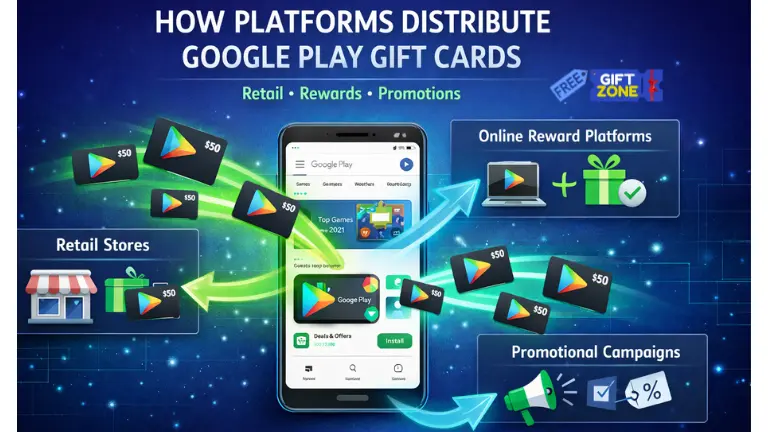
That’s why two broad systems exist in the distribution of Google Play gift cards.
| Distribution Type | Managed By | Funding Source | Code Origin |
|---|---|---|---|
| Retail Purchase | Authorized sellers | Customer payment | Official distributor |
| Promotional Reward | Online platforms | Advertising revenue, sponsorships, and affiliate commissions | Official distributor |
Official Google Play Gift Card Distribution
Retail Distribution Through Physical and Digital Sellers
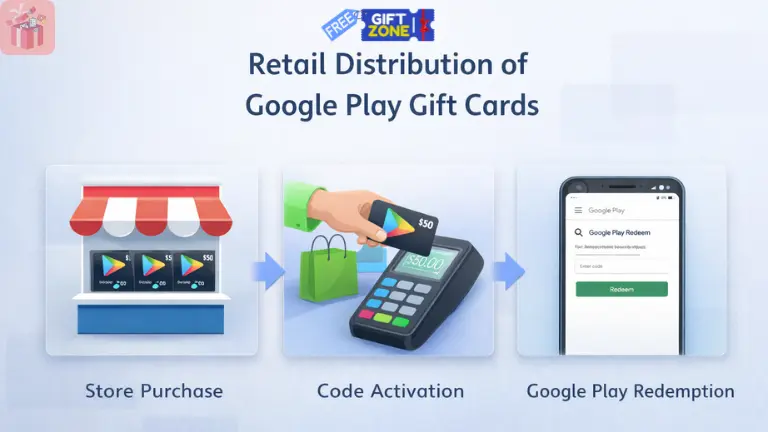
The first and most common method of distribution happens through retail sellers that are officially allowed to sell Google Play gift cards. These sellers may include electronics stores, supermarkets, online marketplaces, and digital storefronts that are connected to approved payment systems.
Physical gift cards are manufactured with unique alphanumeric codes that are printed under a scratch panel. These cards are shipped to retail stores where they are displayed and sold to customers. At the moment a customer purchases the card at the billing counter, the code attached to that card becomes activated through the retailer’s payment system.
Physical Card Flow
- Cards are manufactured with a hidden redemption code.
- Retail stores receive batches of cards from authorized distributors.
- A customer purchases the card at the store counter.
- The billing system activates the code during the payment transaction.
Digital purchases follow a slightly different process but still remain connected to official payment systems.
Digital Card Flow
- A customer purchases a digital code from an approved website.
- Payment is processed through a recognized payment gateway.
- The system generates a digital receipt after the payment confirmation.
- The code is delivered to the buyer through email or the purchase account dashboard.
After receiving the code, the user enters it into the Google Play account. The value of the card then appears in the wallet balance of that account and can be used for purchases inside the Play Store.
Direct Distribution of Preloaded Digital Codes
Some sellers distribute digital codes directly without selling a physical card. These codes are prepared in advance by distributors and are attached to a particular region and currency.
| Attribute | Description |
|---|---|
| Code Format | Alphanumeric redemption code prepared by the distributor |
| Region Assignment | Code linked to a specific country |
| Currency | Wallet value is attached to that country |
| Validation | Code checked by Google Play during redemption |
When a user enters the code inside a Google Play account, the system checks if the account region matches the country associated with that code. If the region does not match, the redemption process can fail because the currency and country do not align with the account settings.
Promotional Distribution Through Online Platforms
Platforms That Provide Rewards After Users Complete Tasks
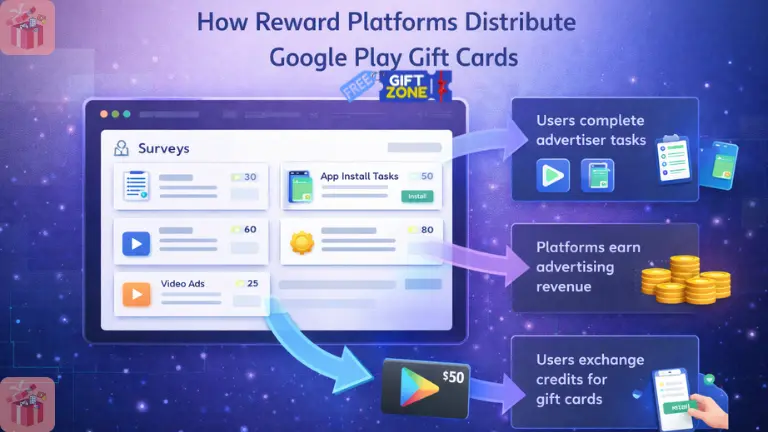
Many online reward websites and mobile applications distribute Google Play gift cards after users complete certain advertiser tasks. These tasks are provided by advertising networks that pay the platform when a user finishes a survey, installs an application, watches a video advertisement, or signs up for a partner service.
The platform collects advertising revenue after the advertiser confirms that the required action was completed. A portion of that revenue is then converted into reward credits that users can exchange for a Google Play gift card.
Examples of user actions that generate reward credits
- Completing a consumer survey
- Installing a promoted mobile application
- Watching a video advertisement until completion
- Creating an account on a partner service website
After enough credits are accumulated in the user account, the user may request a gift card reward. The platform then assigns a code from its stored inventory of purchased gift cards.
| Step | Process |
|---|---|
| 1 | A user completes an advertiser task |
| 2 | The advertiser confirms the task completion |
| 3 | The platform receives advertising revenue |
| 4 | Reward credits appear in the user account |
| 5 | The user exchanges those credits for a gift card |
The code that the user receives was previously purchased by the platform from a distributor or approved marketplace.
Giveaway Campaign Distribution
Another distribution method appears in promotional campaigns where platforms distribute a limited number of gift card codes during a campaign period. These campaigns usually run for a specific duration and follow a set of participation rules.
Campaign Structure
- Participation rules are announced before the campaign begins.
- The campaign accepts entries during a defined campaign period.
- A selection method determines which participants receive rewards.
- Selected participants receive their codes through the platform account or email.
In this distribution method, participation does not guarantee that every user receives a reward because the number of available codes is limited.
Distribution Funded Through Sponsors and Partners
Brand Funded Promotional Campaigns
Some promotional campaigns are financed by companies that want to promote their products, applications, or services. These companies allocate a marketing budget to reward users who participate in the promotion.
The platform running the campaign manages user participation, records the completed actions, and distributes the rewards when the campaign requirements are satisfied.
| Component | Description |
|---|---|
| Sponsor | Brand financing the promotional campaign |
| Platform Role | The platform manages participation and reward delivery |
| Funding Source | Marketing or advertising budget |
| Reward Type | Digital gift card codes |
After the campaign conditions are met and the activity is verified, eligible users receive gift card codes from the campaign reward pool.
Distribution Financed Through Affiliate Commissions
Some platforms generate income through affiliate partnerships. In these arrangements, the platform receives a commission when a user signs up for a service or completes a purchase through a referral link provided by the platform.
Revenue Flow
- A user clicks a referral link.
- The user registers or purchases a product from the partner website.
- The affiliate network records the successful conversion.
- The platform receives a commission payment.
A portion of that commission revenue is used to purchase gift card codes from authorized sellers. Those codes are later distributed to users who meet the reward conditions set by the platform.
Technical Process of Code Distribution
Procurement of Gift Card Codes
Online platforms that distribute Google Play gift cards do not generate those codes themselves. Instead, they purchase codes from official distributors or trusted marketplaces that sell digital gift card inventory.
| Procurement Method | Description |
|---|---|
| Bulk Purchase | Platforms purchase a large batch of codes at once |
| Direct Distributor | Codes purchased from licensed digital distributors |
| Verified Marketplace | Codes purchased from reputable online vendors |
These codes are stored in the platform’s internal database until a user requests a reward redemption.
Many users also confuse a Google Play gift card with a Google Play balance. The gift card is the prepaid code that platforms distribute. Once you redeem it, the value becomes your Play Store balance. You can read more in Google Play Gift Card vs Google Play Balance: What Is the Real Difference.
User Verification Before Reward Allocation
Before a reward is approved, most platforms perform several verification checks to reduce abuse and prevent automated accounts from collecting large numbers of rewards.
Common verification checks performed by platforms
- Email address confirmation
- Device identification checks
- Internet address monitoring
- Detection of duplicate user accounts
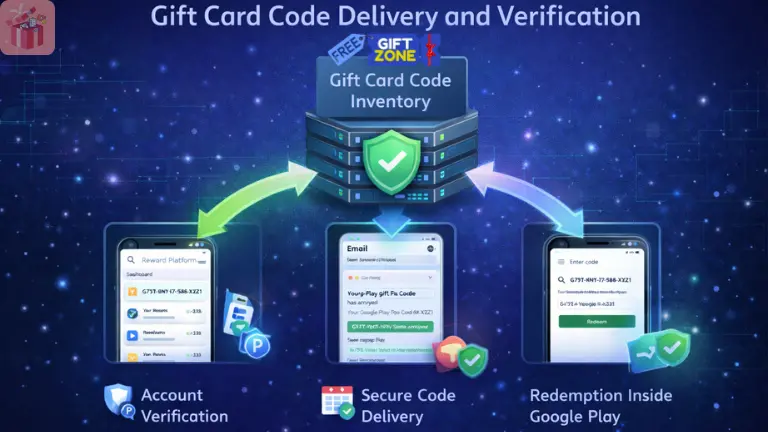
Only after the verification process confirms that the account activity appears genuine and real does the platform allow the reward redemption request to proceed.
Delivery of Gift Card Codes to Users
All the users whose reward requests have been approved receive their gift card codes through delivery methods used by the platform to send the code to the user’s account or registered email address.
| Delivery Method | Description |
|---|---|
| Dashboard Delivery | The code appears inside the user account reward history page |
| Email Delivery | The code is sent to the email address connected to the account |
| Application Reward Page | The code appears in the reward section of the mobile application |
The platform usually records the time of delivery and the account that received the code in order to maintain a record of reward distribution.
Regional Restrictions and Compliance
Google Play gift cards can only be redeemed in the country for which the code was issued. Each code contains a currency value associated with that country only.
Compliance requirements that affect redemption
- The Google Play account must belong to the same country as the code.
- The currency assigned to the code must match the account region.
- The redemption process must follow Google Play Store policies.
If the account country and the code country do not match, the system may reject the redemption request.
Abuse Prevention and Security Controls
Platforms that distribute digital rewards normally operate systems that attempt to prevent large scale abuse of the reward system and protect the stored inventory of gift card codes.
Examples of measures used by platforms to reduce abuse
- Filtering accounts that appear to be duplicates
- Monitoring internet addresses used by accounts
- Limiting how frequently a user can request rewards
- Enforcing waiting periods between reward redemptions
These controls attempt to reduce automated sign-ups and repeated reward withdrawals that could deplete the platform’s inventory of purchased codes.
The Google Play payment ecosystem manages how gift cards, credits, and payments move inside your account. When you redeem a gift card, the value is added to your Play Store balance and stored securely in your Google Play wallet. You can understand this system better in our guide on Google Play Payment Ecosystem and Balance Handling.
Transparency Indicators
Platforms that openly explain how their reward systems operate usually publish information about the source of their rewards, the requirements that users must complete, and the number of rewards available in promotional campaigns.
Information commonly displayed by transparent platforms
- Explanation of how rewards are funded
- Minimum credit requirement for redemption
- Participation conditions for promotional campaigns
- Clear distinction between retail gift card purchases and promotional reward distribution
The method used to redeem the gift card remains the same regardless of how the user obtained the code.
Conclusion
Google Play gift card distribution reaches users through two different paths. One path is a retail purchase from an authorized seller where the customer pays for the card directly. The second path is through promotional campaigns or reward platforms, where the platform distributes codes that were previously purchased using advertising income, sponsorship funds, or affiliate commissions.
In both situations, the code itself still originates from authorized distributors that supply digital gift card inventory. The difference lies only in the funding source and the conditions that determine how the code reaches the user.
| Comparison Area | Retail Purchase Distribution | Online Platform Promotional Distribution |
|---|---|---|
| Payment Source | Customer payment at the store or online checkout | Advertising revenue, sponsorship funds, affiliate commissions |
| Reward Guarantee | Code delivered immediately after purchase | Code delivered only after participation or selection |
| Code Origin | Authorized digital distributor | Authorized digital distributor |
| Redemption Method | Redeemed inside the Google Play account | Redeemed inside the Google Play account |
Frequently Asked Questions
1. Do platforms create Google Play gift card codes themselves?
Online platforms do not generate official Google Play gift card codes. These platforms purchase codes from distributors or approved sellers and store those codes until a user redeems a reward through the platform.
2. Why do some users not receive a gift card after participating?
Reward distribution depends on several conditions, including advertiser confirmation, verification of the user’s activity, the availability of reward inventory, and fraud detection checks performed by the platform. If one of these conditions is not satisfied, the reward request may not be approved.
3. Can a gift card code be used in any country?
A Google Play gift card can only be redeemed in the country assigned to the code. The Google Play account must belong to the same country and currency region as the gift card for the redemption process to succeed.
4. Is redemption different for retail and promotional rewards?
The redemption process is identical regardless of where the gift card was obtained. The user enters the alphanumeric code inside the Google Play account, and the wallet balance updates after the system validates the code.